Table of contents
How to say “I” in Norwegian
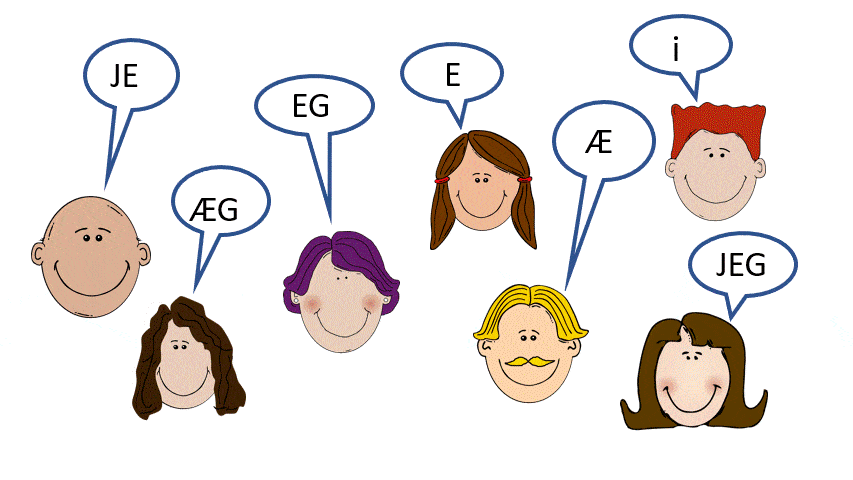
The illustration above shows you the different ways of saying “I” in Norwegian. Norway has numerous local dialects that differ from each other in pronunciation, grammar, and vocabulary. If you have learned some Norwegian, you have probably already noticed these differences.
Regional variation in the spoken language developed in a time when people could not easily travel. However, local dialects are still in use today, despite modern means of communication. In this blog post, I will show you some examples from different parts of the country. If you listen carefully, you should be able to hear the differences even if you have very limited knowledge of Norwegian.
Why all these dialects in Norway?
In every country, there is regional variation in how people speak. However, Norway is a special case because the traditional dialects are in use far more than in most other countries. Speaking dialect in every situation is normal and usually also accepted.
For centuries, Norway was part of the Danish kingdom. In 1814, Norway left the union with Denmark, but without having its own national language. Norwegian and Danish (and Swedish) are considered different languages today, although they have much in common.

It took a long time to develop a standardized Norwegian language. The lack of one clear standard is one of the reasons why people continued to speak dialect. But the position of the regional dialects has also been secured by the lawmakers. School children learn the official way of reading and writing – however, they speak their own local dialect in class. Throughout Norway, people prefer to express themselves in their real mother tongue – the dialect – when they speak. When writing, you use Bokmål or Nynorsk.
Even celebrities speak dialect in Norway
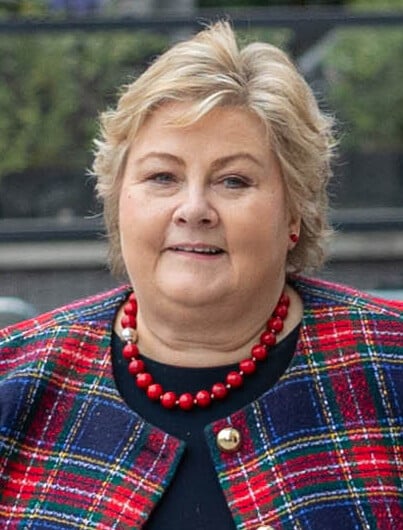
Quite a few celebrities in Norway speak their own dialect, although it may be less clearly pronounced once they move away from their place of birth. You can easily hear that Crown Princess Mette Marit comes from Kristiansand, even after living in the Oslo area for many years. You can also easily hear that former Prime Minister Erna Solberg comes from Bergen.
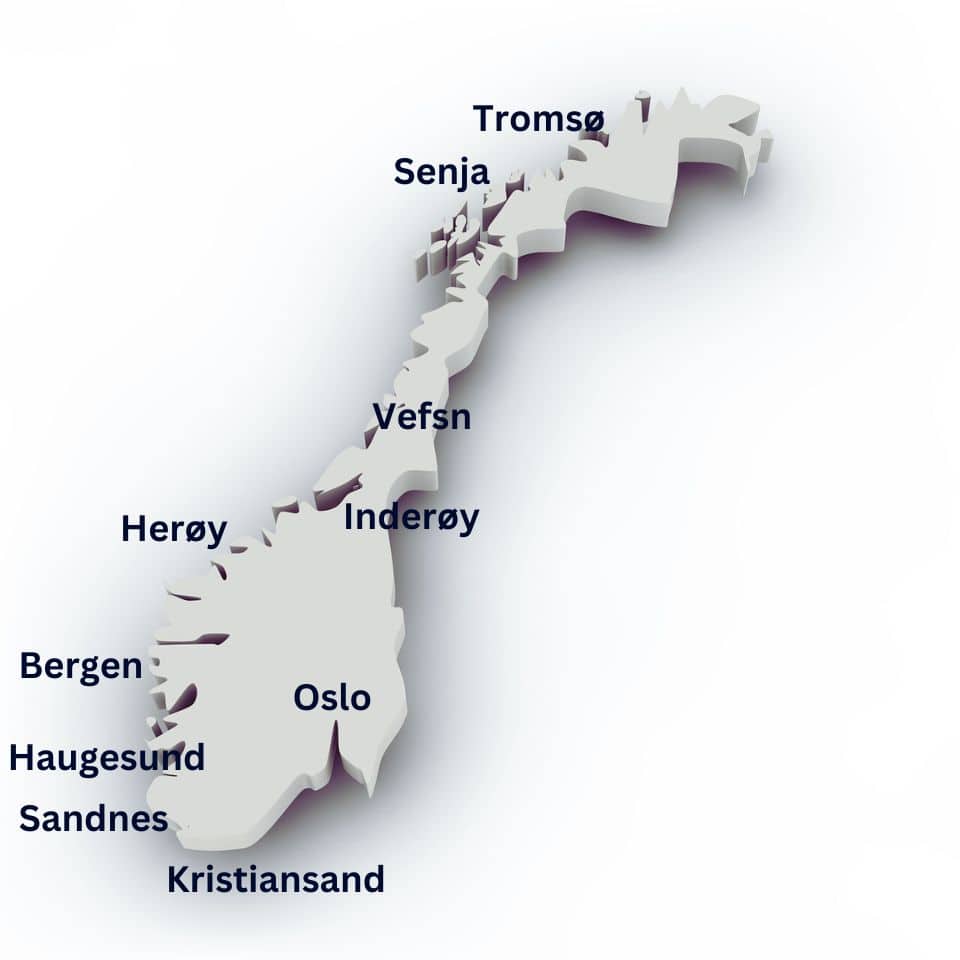
If you study Norwegian as a foreign language, you might find this regional variation frustrating. However, this variation also gives you more freedom when it comes to how to speak the language. There are regional differences in intonation and pronunciation, and there is often more than one way to pronounce a word correctly. To make you understand things better, I have included this map to show you which places I refer to in this blog post.
Comparing some dialects
In the following, I will give you some examples. You will find two sentences in five different dialects. On the top, you will see what the sentence is in standard Norwegian Bokmål, including a (almost) literal translation into English. The Oslo vlice is the one coming closest to Bokmål.
“Jeg har ikke sett henne i kveld” (“I have not seen her tonight”)
Oslo
Sandnes
Herøy
Innherred
Tromsø
“Hun holder den svarte hunden i bånd” (“She keeps the black dog on a leash”)
Oslo
Sandnes
Herøy
Inderøy
Vefsn
Norwegian music in dialect
Quite a few Norwegian musicians sing in their own dialect. Often they do so because they feel that it is the only way they can express themselves properly. However, these musicians still often manage to reach a larger audience all over the country. In the following, I have chosen a couple of tunes in dialects that are clearly different from each other.
First I will show you an example from the southwest of Norway, from Haugesund. Here you can listen to Vamp’s “Natt” (night).
Again, a tour of Norway will not be complete without going north of the Arctic Circle. Moddi comes from the island of Senja, although in this tune (and video), he refers to other places in the north.
Do you want to hear more music in Norwegian? Check out this blog post: A musical journey through Norway
Do I need to speak like the locals?
Are you learning Norwegian, or are you planning to study it? Are you moving to an area where a dialect is spoken? In my opinion, there is no reason to worry. You don’t need to learn how to speak the dialect, but you do need to be able to understand it. My experience is that most non-native speakers manage this well after some time.
There is a stronger acceptance for regional variation in Norway than in most other countries, these differences are becoming smaller. Nevertheless, in large areas of the country, dialects still form the basis of everyday life – for people of all generations.
I hope you have enjoyed reading this introduction to the dialects of Norway. On this blog, you will find more articles about other aspects of Norway and the Norwegian language.
norwegian.online offers private online language lessons. There is more information to be found on this site. Don’t hesitate to get in touch if you are interested.